Your training, nutrition and progress in one place. Follow a structured plan, log every set, track calories and protein, and see how your strength changes over time.
A calorie target worked out from your body, your day and your training. Food logging that keeps protein in view. A weight trend that shows whether it's working.
A calorie target built for you
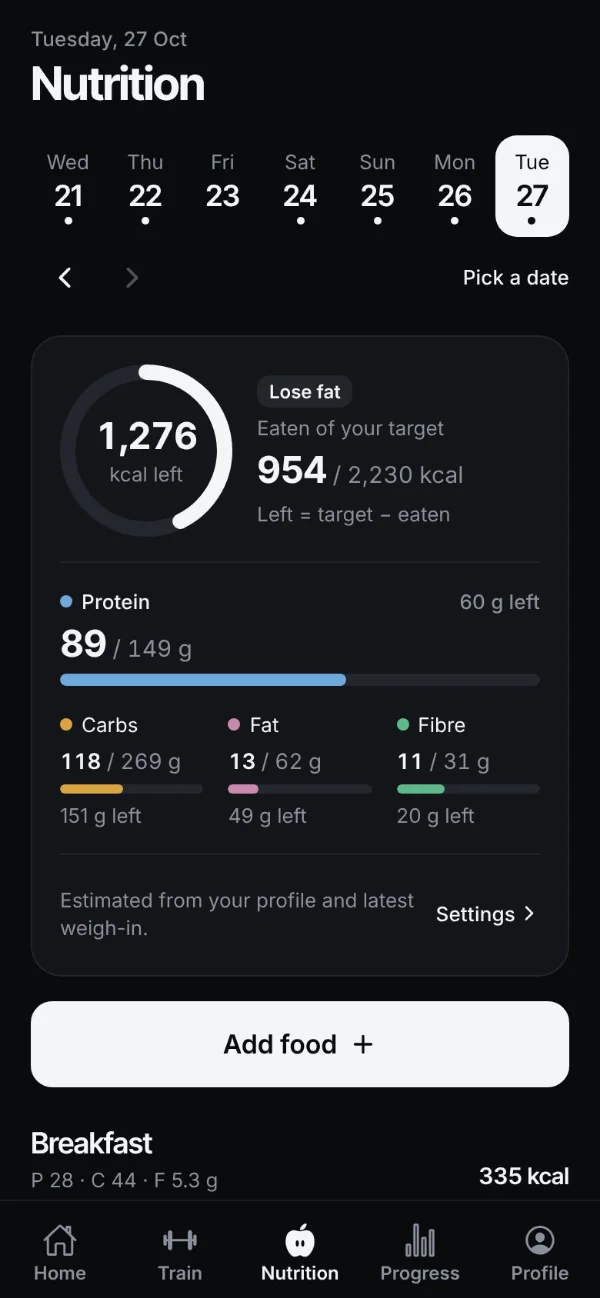
Estimated from your resting energy (the Mifflin-St Jeor equation), your daily activity and your planned training. To lose fat it sits 500 kcal below your estimated maintenance, never below your resting energy, and it updates when you log a new weight. Prefer your own number? Set it.
Food, calories and protein
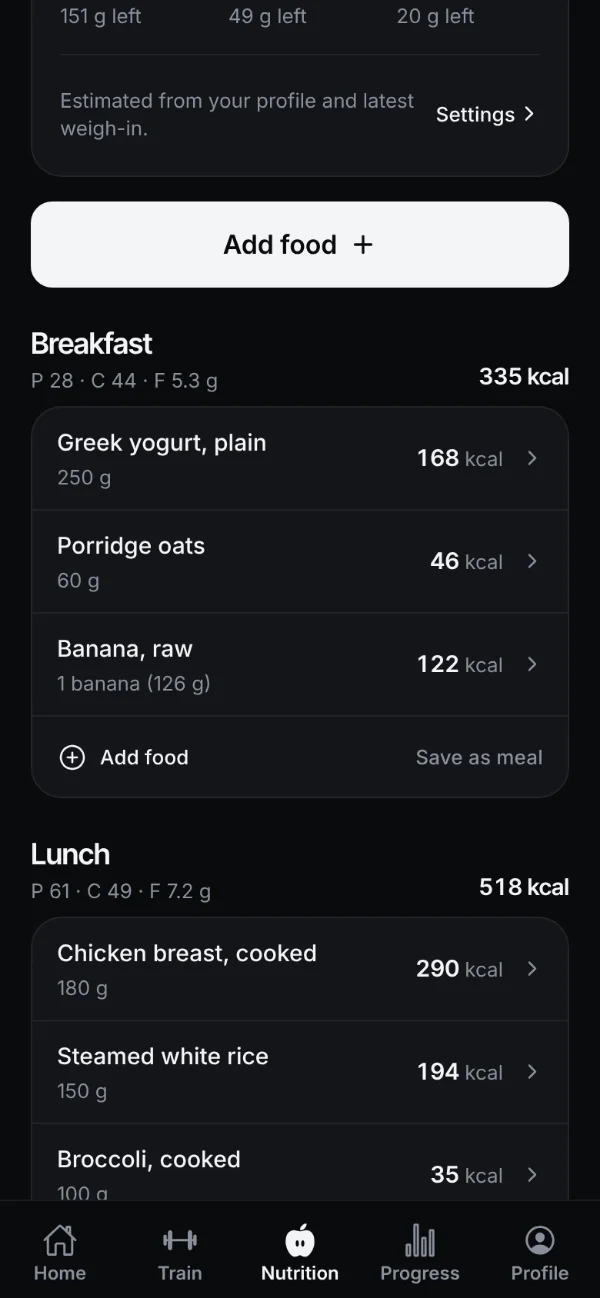
Search more than 13,000 foods with values from USDA FoodData Central, log by grams or servings, save meals you eat often, and see calories, protein, carbohydrate, fat and fibre against your day's targets.
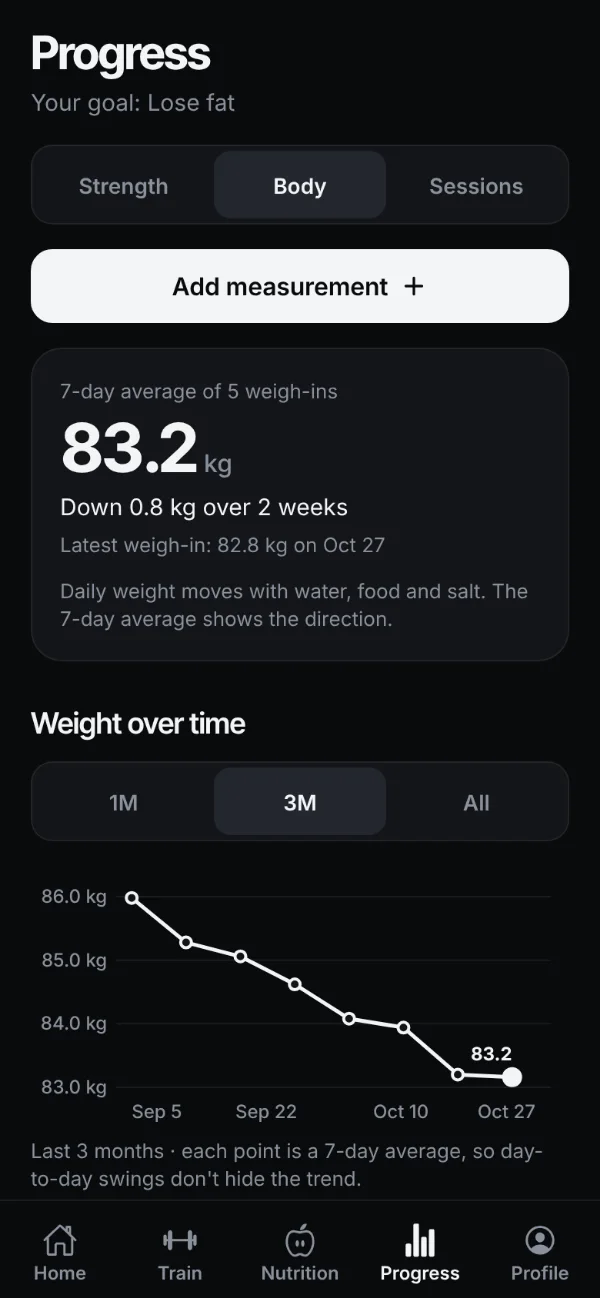
A weight trend, not a daily verdict
Weigh in when you like. Progress shows a 7-day average so day-to-day swings in water and food don't hide the direction. Log your waist and other measurements too.
Calorie targets are estimates and a weight trend is a guide, not a promise: people respond differently, so judge it over a few weeks. FitX AI doesn't set calorie targets for anyone under 18.
Food log
Body weight
02 Build muscle
Build muscle, and know it's working.
Every set you log becomes data. Instead of guessing whether your training is paying off, you can see it lift by lift.
Progressive overload, built in
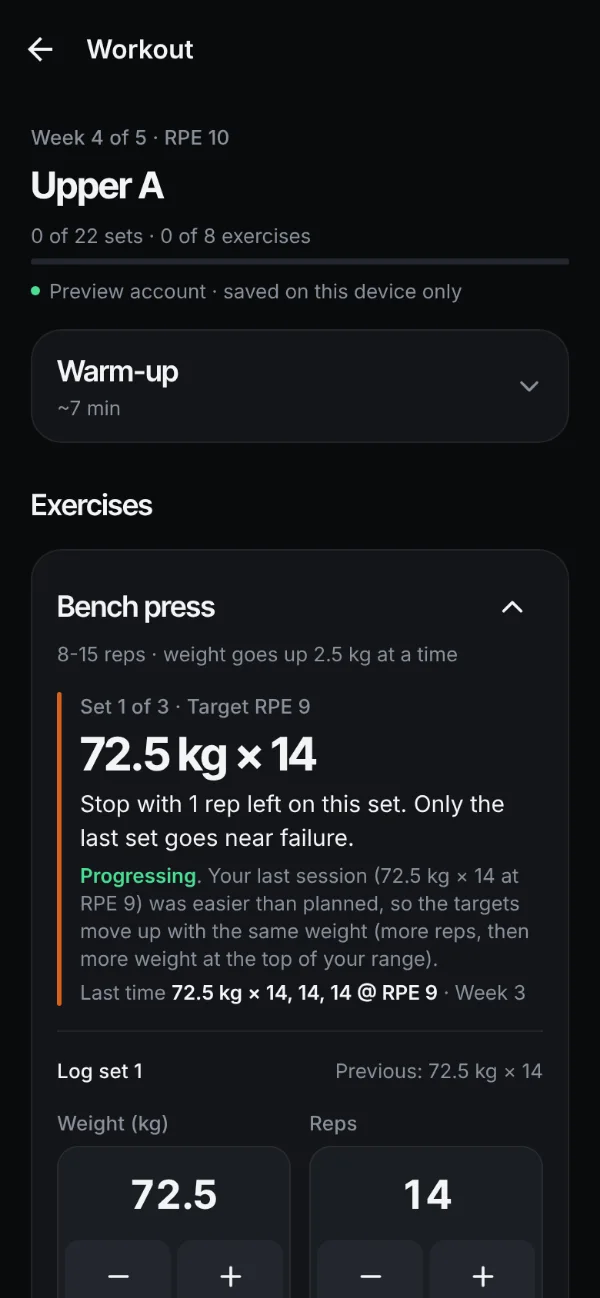
Reps rise inside your range first. Reach the top of it at the planned effort and the weight goes up: at least 2%, or 5% for leg and hip lifts.
Every set on record
Weight, reps and reps in reserve for every set, each session saved by block and week, and what you lifted last time shown before you start.
Estimated one-rep max
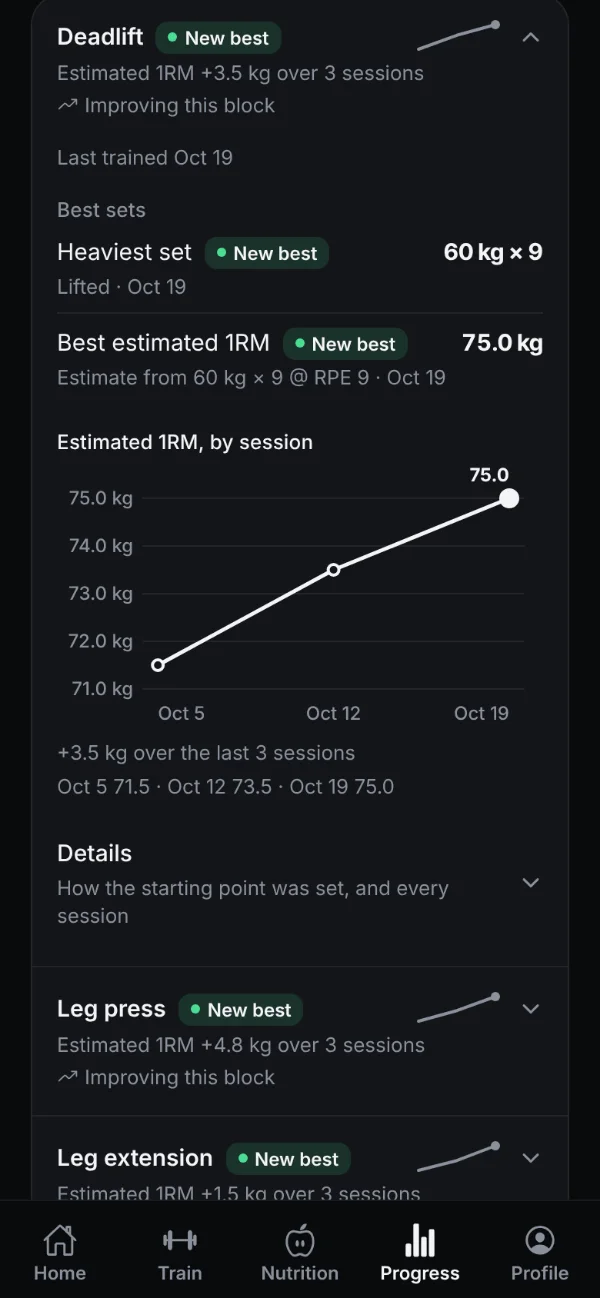
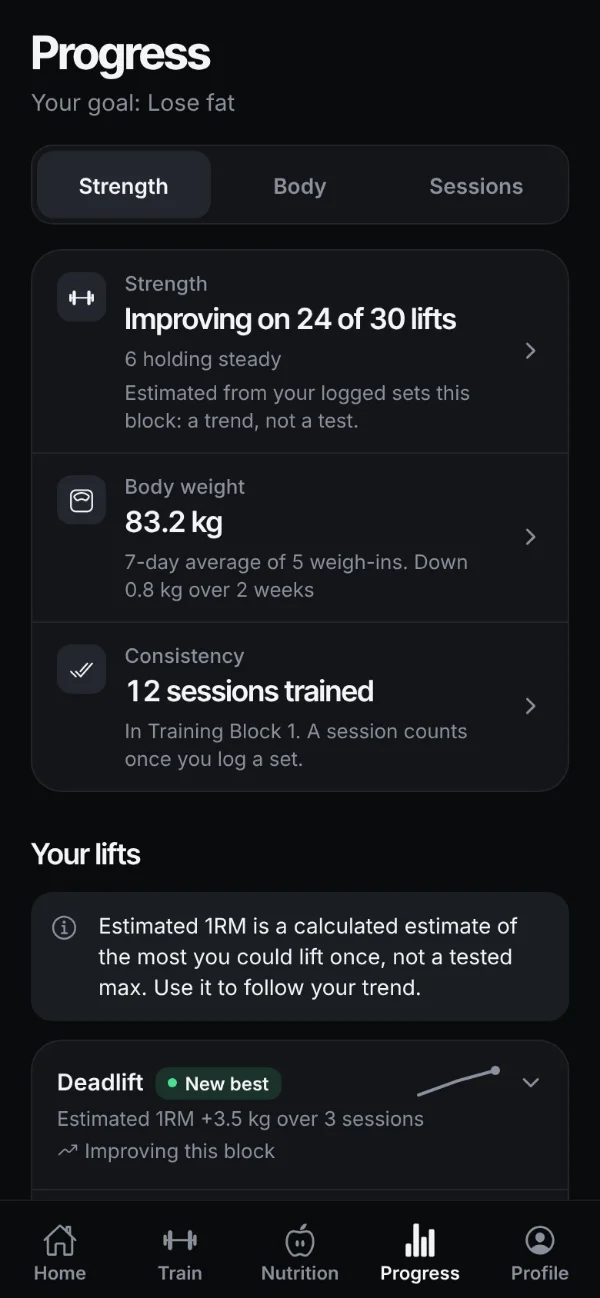
Every rated set gives an estimated 1RM, charted for each lift with new bests marked. It's a trend to follow, not a tested max.
Plateaus spotted
When a lift's estimated strength hasn't risen across several sessions, FitX AI says a plateau is possible and suggests a small next step.
Workout
Progress
03 Train with a plan
Train with a plan, not a guess.
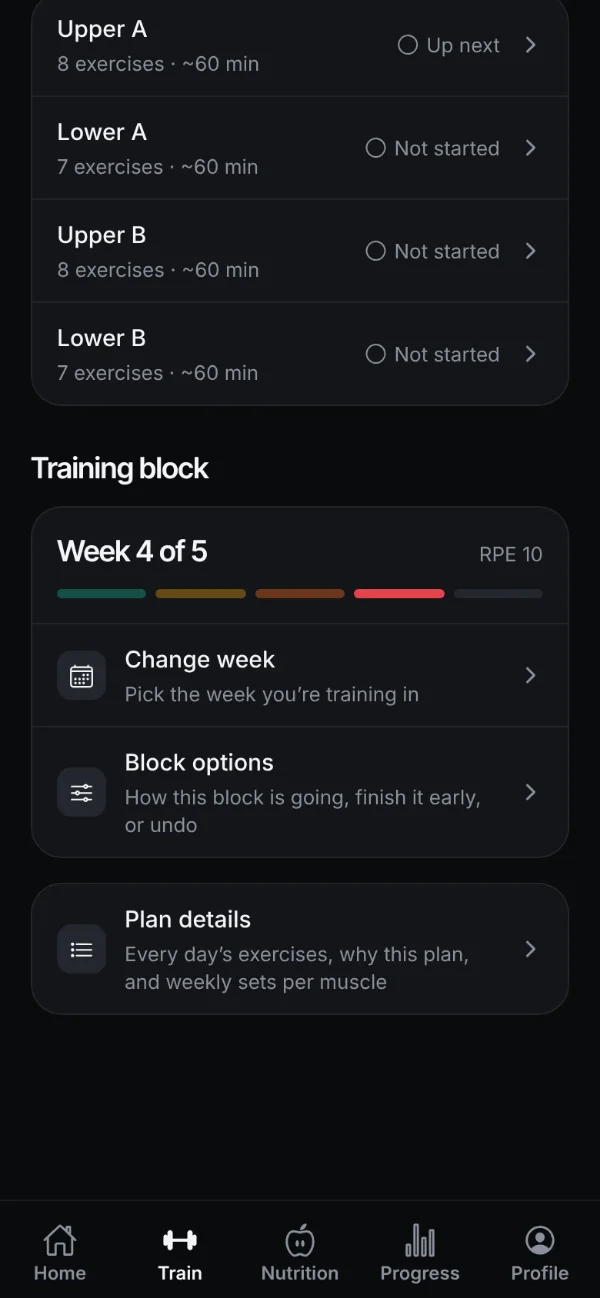
FitX AI builds a plan from your goal, experience, schedule and equipment, then runs it in five-week training blocks with effort that rises week by week.
Week 1RPE 7About 3 reps left. A lighter start that calibrates your targets.
Week 2RPE 8About 2 reps left.
Week 3RPE 9About 1 rep left.
Week 4RPE 9-10The last set of each exercise goes to RPE 10.
Week 5DeloadSame weights, half the sets, around RPE 5-6.
Effort you rate, targets that respond
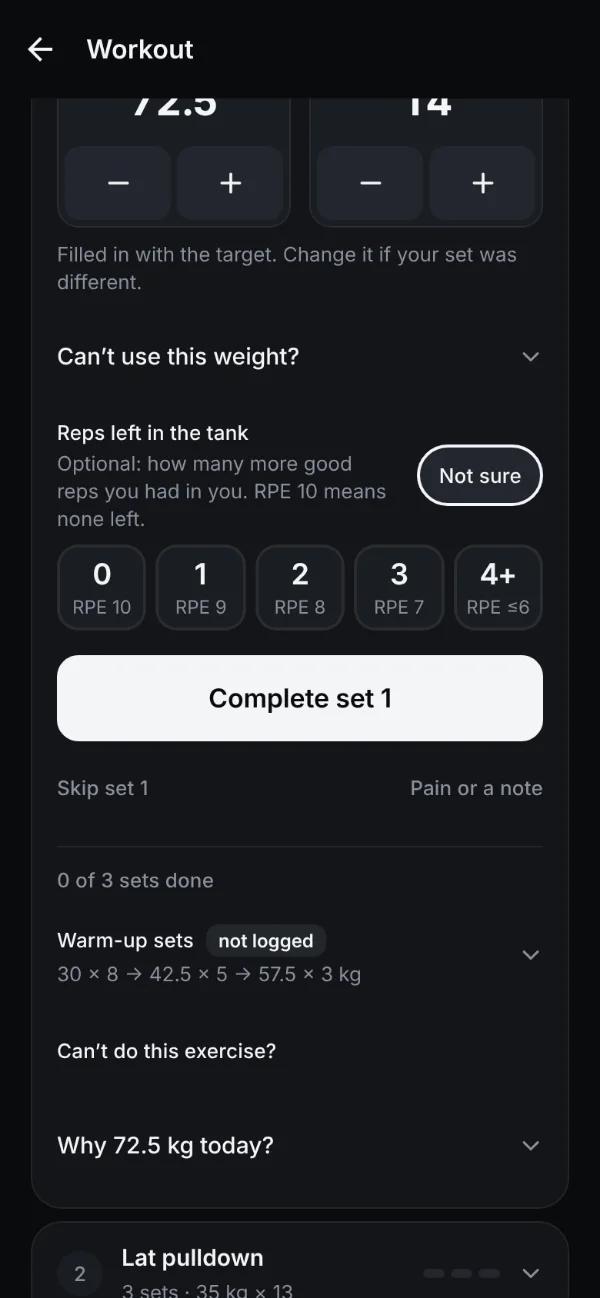
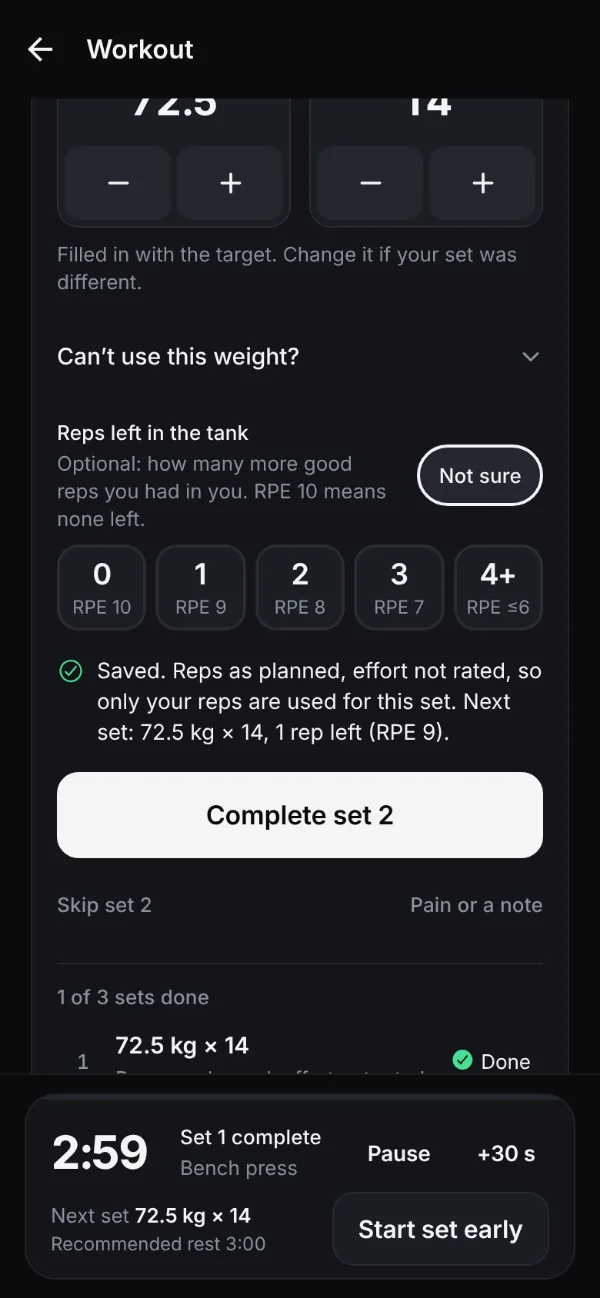
After each set, tap how many more good reps you had in you. RPE 8 means about two left. Your next targets follow what you actually did.
Weekly sets for every muscle
8-12, 12-16 or 16-20 hard sets a week for major muscles, depending on your experience, with each muscle usually trained on two days.
Recover, then build again
Week 5 is a lighter deload. The next block starts from what you lifted, with starting weights raised by at most 10%.
Help in the moment
Warm-up sets, a recommended rest timer you can end early, and options when you can't use a weight or can't do an exercise.
Your plan comes from your answers, so the split, exercises and set counts differ from person to person. The ranges and the block structure are FitX AI's own choices, informed by the research below.
Reps left
Rest timer
04 Nutrition and training, connected
Your training and your food, in one place.
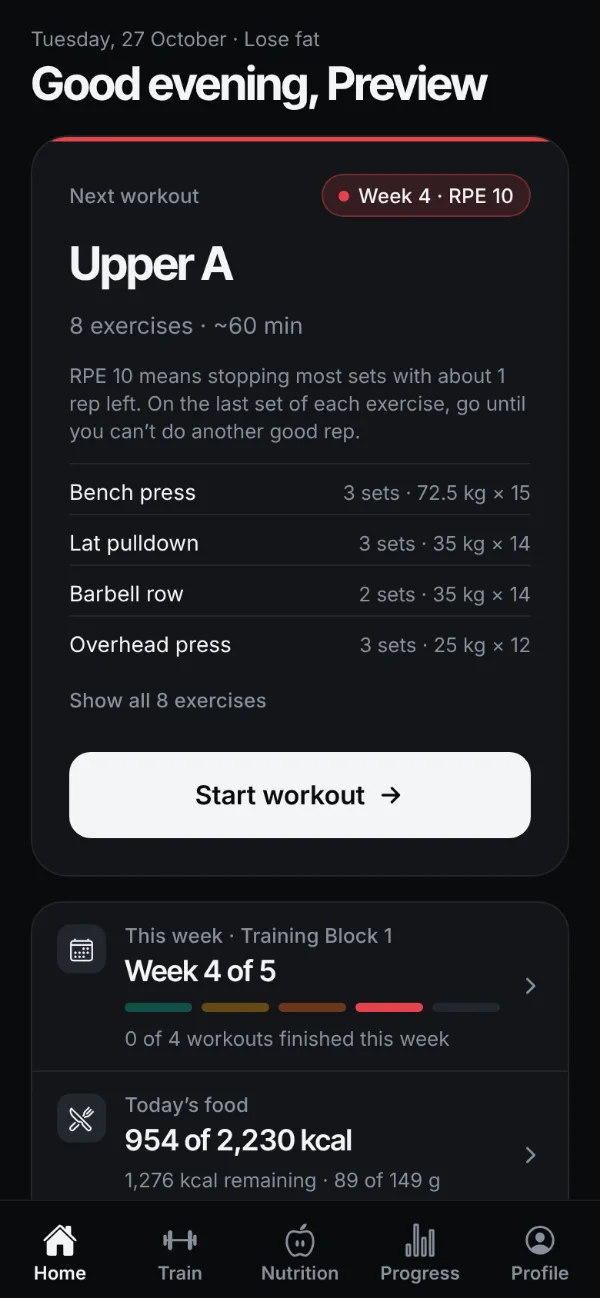
One profile drives both. Your goal, body, daily activity and training schedule shape your plan and your calorie target, and Home puts today's workout and today's food side by side.
One profile, two plans
Set your goal once: lose fat or build lean muscle. It shapes the exercises chosen for your plan and the calorie target you eat to.
Training counts toward your energy needs
Your planned training is part of your daily calorie estimate, so a heavier schedule is reflected in what you eat.
Today, at a glance
Your next workout, this week's sessions and how much of today's target you've eaten, on one screen.
FitX AI works from what you log. It doesn't read photos of food, connect to wearables or health apps, or make medical recommendations.
Today
05 See your progress
See your progress, not just your effort.
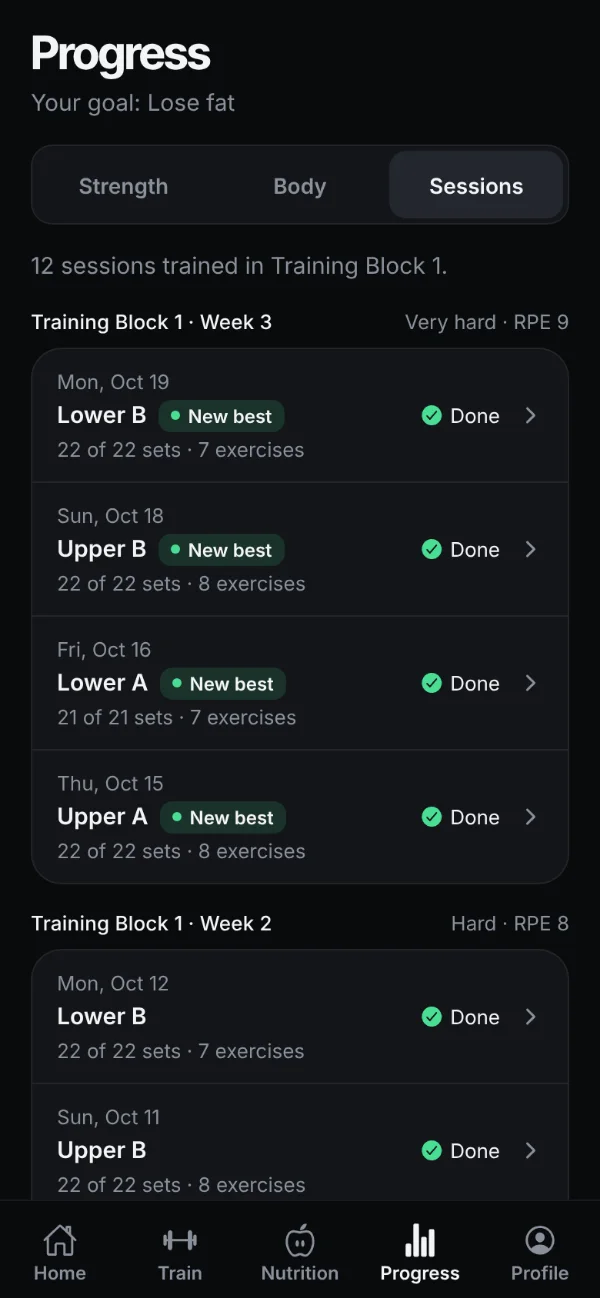
Progress brings your strength, your body and your sessions together, so the changes that take weeks are easy to see.
Strength
An estimated 1RM trend and best sets for every lift, and whether each one is improving, holding steady or has hit a plateau this block.
Body
Body weight as a 7-day average over one month, three months or all time, plus waist and other measurements.
Sessions
Every workout by block and week, with the sets you did. Open one to see each set, or correct a set you logged wrongly.
Nutrition history
Step back through past days, or pick a date, to see what you ate and how it compared with your targets.
Strength trend
Sessions
06 The science
Built on research you can check.
FitX AI's training and nutrition rules come from exercise and nutrition science. For each principle: what is well established, what is less certain, and what the app does with it, with links to the original papers.
34Peer-reviewed papers
18Meta-analyses and systematic reviews
01
Progressive overload
Muscles keep adapting when the challenge keeps growing.
Well established
Strength and muscle respond to a load that rises over time. The ACSM position stand recommends a 2-10% load increase once you can beat your target reps, and in a trial adding reps worked as well as adding weight.
Less certain
How big each step should be is a judgement call. FitX AI's 2% and 5% minimum steps sit inside the ACSM range, but they are product choices, not research findings.
In FitX AI
Reps rise inside your range first. Reach the top at the planned effort and the weight goes up by at least 2% (5% for leg and hip lifts).
Effort is rated by the reps you had left, and targets follow it.
Well established
Rating a set by its reps in reserve is a practical effort scale. Muscle growth improves as sets end closer to failure, and going all the way to failure is not clearly better than stopping a little short.
Less certain
Ratings are self-reported: people tend to underestimate by about a rep, and are more accurate close to failure. The RPE 7-8-9-10 ladder and the five-week length are FitX AI design choices; the papers don't prescribe this exact schedule.
In FitX AI
After each set you tap how many reps you had left. Week 1 calibrates, and one rating moves your next targets only a little.
Enough hard sets, a sensible rep range, and planned recovery.
Well established
More weekly sets per muscle tend to give more growth, with diminishing returns. Muscle grows across a wide range of loads when sets are hard. With weekly sets matched, training a muscle once or twice a week gives similar growth. Deloads are an established way to manage fatigue.
Less certain
The research gives trends, not individual prescriptions: FitX AI's 8-12, 12-16 and 16-20 set bands are its own choices. Evidence on rest between sets is mixed, and halving the sets in a deload week is a product choice.
In FitX AI
Weekly sets per muscle by experience, each muscle usually twice a week, an 8-15 rep working range, a recommended rest after each set, and a deload in week 5.
Energy needs can be estimated, and they change as you do.
Well established
Resting energy needs can be estimated from weight, height, age and sex with the Mifflin-St Jeor equation. Body weight responds slowly to a change in calories, and needs shift as weight changes.
Less certain
Any estimate can be off for one person, and activity multipliers are approximations. In one meta-regression, lifting in a deficit of about 500 kcal a day held back lean-mass gains. FitX AI's 500 kcal deficit is applied whatever your size, and its +150 kcal surplus has no reviewed paper behind it: both are product choices.
In FitX AI
A daily calorie target from your estimated resting energy, activity, training and goal, recalculated from your latest weigh-in. Your real weight trend is the check.
Enough daily protein supports muscle; much more adds little.
Well established
For most people who train, 1.4-2.0 g of protein per kg of body weight a day is sufficient. In a meta-analysis of 49 trials, extra gains in fat-free mass levelled off above about 1.6 g/kg a day on average.
Less certain
These are averages and individual needs vary. Higher intakes may help keep lean mass in a calorie deficit, but that evidence is less firm. How the rest of your calories split between carbohydrate and fat is a product choice; no diet type is presented as better.
In FitX AI
A protein target of 1.8 g per kg of body weight by default, adjustable from 1.6 to 2.2, with carbohydrate, fat and fibre filling the rest of your target.
Follow the trend over weeks, then adjust from what happened.
Well established
A one-rep max can be estimated from multi-rep sets, most precisely from sets of fewer reps. Because weight responds slowly to a change in calories, single weigh-ins say little on their own.
Less certain
An estimated 1RM varies from day to day and depends on how accurately you rate reps left. FitX AI's stall check uses its own thresholds, not validated cut-offs, and only ever says a plateau is possible.
In FitX AI
An estimated 1RM from every rated set, charted per lift; a 7-day average body weight; each new block starting from what you lifted, with increases capped at 10%.
Every citation is checked against Crossref and PubMed (last on 2026-10-09) and summarised from its published abstract. Research supports the principles; FitX AI itself has not been tested in a clinical trial, and results vary between people.
Your goal, experience, training days and session length, gym or home equipment, body measurements and any injuries. It builds your training plan and your daily targets from your answers.
2
Train and log
Follow today's workout and log each set's weight, reps and reps in reserve. Log your food from the catalogue or add your own.
3
Watch the trend, then adjust
Your next targets follow what you actually did. Check your strength, body weight and sessions, and change your goal or settings whenever you need to.
08 Inside the app
Take a look around.
Today
Workout
Reps left
Rest timer
Training block
Nutrition
Food log
Progress
Strength trend
Body weight
Sessions
Real screens from the FitX AI mobile app, using a demo account with sample data.
Start your next block with FitX AI.
Coming soon to iPhone and Android. Training, nutrition and progress in one app.